Tokyo Helicopter Tours With Kids: Ages, Rules and Which Flight

Yes, children can join a Tokyo helicopter tour, and unlike most helicopter sightseeing operators, there is no fixed minimum age here. The real gate is not a birthday, it is whether a child can climb the roughly 20 centimeter step into the cabin without being lifted or carried. When I went through every child policy published for these Tokyo flights, that single mechanical detail turned out to matter more than any number in the fine print. Below is which flight fits which age, what a three-seat cabin is actually like for a young child, and what to do instead if your family isn't quite ready yet, including the one flight that seats a family of four together. Once you know the age math, browse the full lineup of family helicopter flights over Tokyo and pick accordingly.
Quick answer
Kids can fly on a Tokyo helicopter tour at any age, since there is no fixed minimum, only a requirement that they climb the roughly 20 centimeter cabin step unaided. In practice that puts most toddlers and cautious younger children on the shortest flights, while older kids and teens handle the longer downtown and Mount Fuji routes comfortably.
Key takeaways
- There is no fixed minimum age; the real requirement is climbing the roughly 20 centimeter cabin step without being carried
- One child under 2 can ride free on an adult's lap, but confirm it in advance since some flights don't allow it
- Age 3 and up takes its own seat and its own weight allowance, and counts as a full passenger
- The 10-minute Tokyo Bay flight and the 15-minute Skytree flight suit the shortest attention spans
- Only one flight, the Skytree and Tokyo Station route, seats a family of four together
- The 90-minute Mount Fuji charter is a long sit for a young child, better suited to teens and adults
Which Flight Fits Which Age
Every flight on this roster works for some age and not for others, mostly because of duration rather than anything else. Here is the honest match, ranked from shortest to longest.
| Flight | Duration | Seats | Price | Best for ages | Why |
|---|---|---|---|---|---|
| Tokyo Bay Helicopter Tour | 10 min | up to 3 | from $504/group | 3 to 6 | Shortest flight on the roster, matching a toddler's real attention span |
| Skytree, Shibuya & Shinjuku Flight | 10, 20 or 30 min | 1 (per seat) | from $561/person | 7 to 12 | Lets a family pick the duration to match one child's stamina instead of booking blind |
| Tokyo Skytree Private Tour | 15 min | up to 3 | from $733/group | 5 to 10 | A landmark most kids already recognize before they even board |
| Skytree & Tokyo Station Tour | 15 min | up to 4 | from $989/group | any age, family of four | The only flight that seats two adults and two kids together in one cabin |
| 25-Minute Downtown Tour | 25 min | up to 3 | from $1,258/group | 8 and up | A longer loop with more landmarks, suited to a kid with more patience |
| Mt. Fuji + Kamakura Private Tour | 90 min | up to 3 | from $4,541/group | teens and adults | Ninety minutes is a long sit for a small child; save this one for an older kid who chose to come |
Is There a Minimum Age?
No. Unlike most helicopter sightseeing operators, AIROS Skyview sets no fixed minimum age for these Tokyo flights. The requirement is physical, not chronological: every passenger has to walk to the aircraft and climb the roughly 20 centimeter step into the cabin unaided, without being lifted or carried by a parent or crew member. A child who manages that step confidently can fly, whatever the birthday says.
One exception softens this. A single child under 2 can ride free on an adult's lap, though that needs confirming in advance since some flights don't permit it at all. Once a child turns 3, they take their own seat, their own weight allowance and their own fare, exactly like any other passenger. Weight limits, boarding requirements and who else should reconsider before flying are covered elsewhere on the site; this page only concerns itself with the age side of that question.
Is It Safe for Kids?
Every passenger, kids included, gets the same pre-flight safety briefing and the same belted seat before the doors close; there's no lighter or shorter version for children. A crew member fits every passenger with a headset, checks the seatbelt, and walks through the safety briefing before anyone boards, exactly the same way for a nine-year-old as for an adult. These are commercially regulated flights under Japan Civil Aviation Bureau, JCAB, certification, not casual private hops arranged informally.
The full restriction table, including weight limits and who should think twice before flying, lives in what the operator requires of passengers.
Is Your Child Ready? (It Isn't Really About Age)
Age is a floor, not a guarantee. A child well above the informal ages in the table above can still be a poor fit for a helicopter cabin, and a younger one who clears these markers can do fine. Readiness looks like this:
- Follows a short safety briefing and keeps a headset on for the whole flight, not just the first minute of it
- Stays calm in a loud, enclosed space; the cabin is genuinely loud for the whole flight, which is why everyone wears a headset to talk to the pilot
- Sits belted in place without needing to unbuckle, stand, or move around mid-flight
- Has already climbed a step of roughly 20 centimeters, a curb or a low platform, without a boost from an adult
- Doesn't startle badly at sudden engine noise or vibration, the kind you'd feel on a subway platform or near a running engine
- Has an attention span that matches the flight's actual length, not just the excitement of the ticket
Each of those is worth a dry run before you book. Try noise-cancelling headphones at home for the length of the flight you're considering. A short subway ride or a trip in a loud elevator tells you more about noise tolerance than any reassurance from a brochure. And if you genuinely don't know whether your child can manage the cabin step unaided, have them practice climbing something about that height at home first.
One honest note: a mature, confident 2-year-old does not get an exception to the under-2 lap policy or the unaided-step rule. Operators enforce by policy, not by judgment on the day, so there's no case for presenting a younger child as older to get them aboard.
Which Flight Fits Your Child's Age
If your child is under 2
one child can ride free on an adult's lap as a general operator policy, but confirm this in advance since not every flight allows it; for a first flight, the 10-minute Tokyo Bay tour is still the easiest length to start with.
If your child is 2 to 5
book the 10-minute Tokyo Bay flight or the 15-minute Skytree tour; both sit inside a young child's realistic attention span, and once they turn 3 they'll need their own seat and fare.
If your child is 6 to 9
the 15-minute Skytree flight or the flexible 10 to 20 minute option both work well; if you're four in total, the Skytree & Tokyo Station tour is the only flight that seats everyone together.
If your child is 10 and up
the 25-minute downtown tour or the 30-minute flexible flight give an older kid more time in the air and more landmarks to spot without testing anyone's patience.
If you're a mixed-age family with a toddler and a teenager
pick the flight length that suits the youngest child, not the oldest; a short flight everyone enjoys beats a long one that ends with a bored 4-year-old.
What the Flight Is Actually Like for a Kid
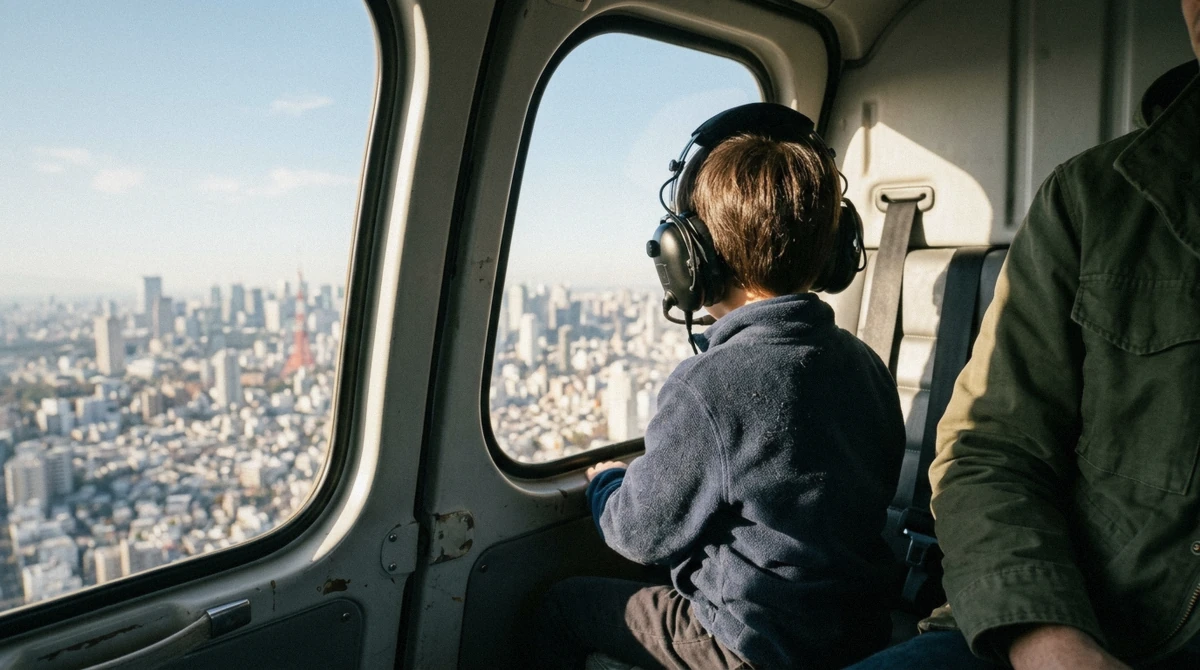
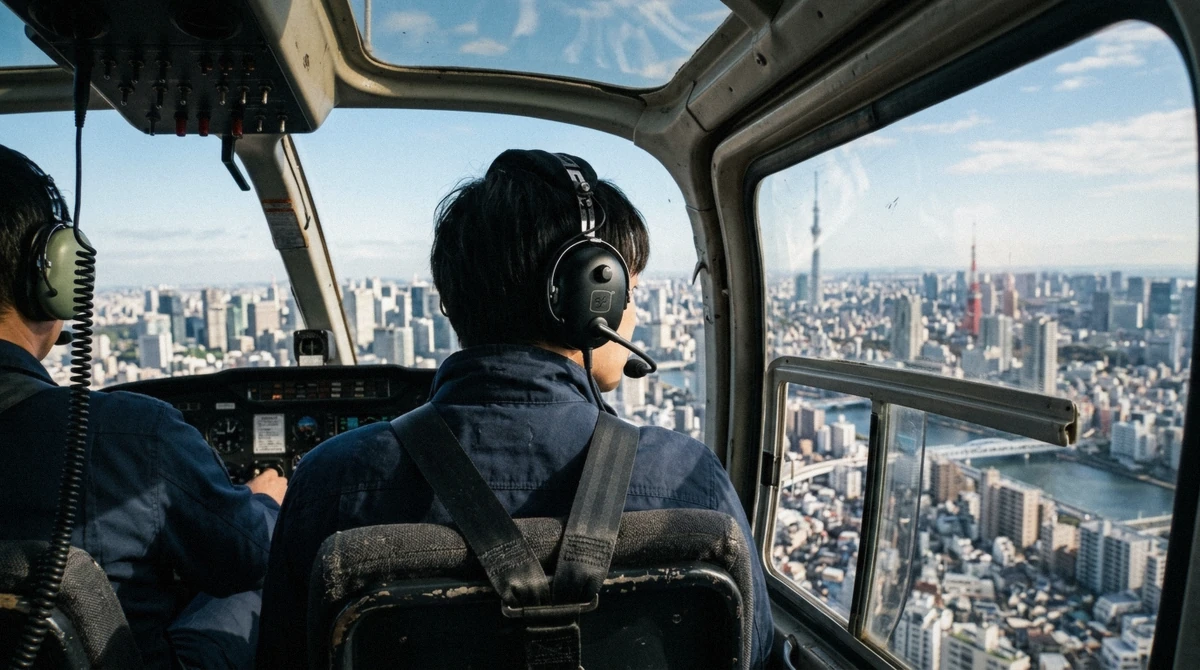
Every flight starts the same way for a child as it does for an adult: check-in at Tokyo Heliport in Koto Ward, a weigh-in, and a short safety briefing before boarding (for the full route to get there, see how to reach Tokyo Heliport). A crew member fits every passenger, kids included, with a headset before the doors close, since the cabin is loud enough that talking over it without one is genuinely difficult.
The first thirty seconds after lift-off tend to be the moment that either hooks a child or unsettles one: the ground drops away quickly, the noise steps up, and there's no easing into it gradually. Most kids who clear the readiness markers above light up right here. The next few minutes bring the first recognizable landmark into view, usually Tokyo Skytree's spire among the landmarks a child will spot, and that moment is often the high point of a young child's attention for the entire flight.
Past the ten-minute mark, a young child's engagement tends to fall off, less from boredom with the view than from the sustained noise and the seatbelt. On a 15-minute Skytree flight, that's a short stretch near the end. On the 90-minute Mount Fuji charter, it's most of the flight, which is exactly why that route suits a teenager far better than a 5-year-old.
As a rule of thumb, a ten or fifteen minute flight suits a young child comfortably, and ninety minutes is a long time to ask a small child to sit belted and harnessed in a loud cabin. None of this means longer flights are unsuitable for families; it means the honest match favors the flight length to the child in front of you rather than the child to the flight you'd like to book.
Which Flight to Book for a Family
A family of exactly four has one real option: the Skytree & Tokyo Station Tour, the only flight on this roster built for four seats instead of three. Everyone rides together in one cabin, with no splitting the group or leaving anyone on the ground.
A family of three fills a private charter on its own, and the per-person cost drops accordingly since most of these flights are priced per group rather than per seat, a mechanic explained fully in how a private charter is priced. The Tokyo Bay Helicopter Tour is the cheapest way to test whether your youngest actually enjoys a helicopter cabin before committing to a longer, pricier route.
Families who'd rather skip the trip out to the heliport altogether, worth considering with a fussy toddler or a lot of gear in tow, can book the 10-Minute Tour with Hotel Pickup & Drop-off, which collects everyone from the hotel and removes that leg of the day entirely.
What to Bring for Kids
This one is short on purpose. There isn't much to pack for a flight this brief, and most of what matters is what to leave behind.
- No bags in the cabin; anything you're carrying stays with the operator during the flight, so travel light
- A form of photo ID for check-in, per person, kids included
- A light layer; the heliport waiting area and the walk to the aircraft are outdoors
- Nothing loose near the rotors: scarves, large hats and selfie sticks aren't allowed near the aircraft
Restrooms and Changing Facilities
Tokyo Heliport has a waiting room and toilets, including a multi-purpose restroom with a changing table, worth knowing before you bring a child who still needs one. It's a modest setup rather than an airport-style facility, but it covers the basics for a family waiting through check-in and the weigh-in. See what else the heliport has on site for the rest of what to expect on arrival.
Eating With Kids Before the Flight
There are no shops and no food at Tokyo Heliport. It's a working airfield, not an airport terminal built for browsing or grabbing a snack, so eat before you arrive, especially with a hungry toddler in tow. There's nowhere on site to fix that once you're there.
Full route and timing details are in the details on getting there and back.
Too Young, or Not Ready? What to Do Instead
Not every family is ready to fly, and that's a fine outcome rather than a consolation prize. Two ground-based alternatives give a child a high view over the city without any age rule at all.
Tokyo Skytree's Tembo Deck costs about ¥1,800 if booked ahead on a weekday, or ¥2,100 same-day, as of July 2026, and gets a child there by elevator instead of a helicopter step. Tokyo Tower's Main Deck runs cheaper, roughly ¥1,200 to ¥1,500. Neither deck has an age rule at all.
Either one works for a toddler who isn't ready for the cabin step, a nervous flyer of any age, or a family simply not ready to spend on a helicopter flight yet. Revisit the helicopter option once your child has grown into the readiness markers above; the aircraft isn't going anywhere.
Frequently Asked Questions
What age can a child fly a helicopter in Tokyo?
There's no fixed minimum age. The real requirement is climbing the roughly 20 centimeter cabin step unaided. One child under 2 can ride free on an adult's lap if confirmed in advance, and age 3 and up takes a full seat and its own fare.
How much do children pay for a Tokyo helicopter tour?
Once a child turns 3, they're a full passenger with their own seat and fare, priced the same way as an adult on that flight. There's no published kids' discount. Only a single under-2 rides free, and only on an adult's lap.
How long can a young child manage in a helicopter?
There is no published figure for this, so treat what follows as judgment rather than a rule. A young child is belted into a harness, wearing a headset, in a loud cabin, and the novelty carries them for a while but not indefinitely. That is why the 10-minute Tokyo Bay flight and the 15-minute Skytree flight suit younger kids far better than the 25 or 30-minute downtown routes, and why the 90-minute Mount Fuji charter is a long sit for anyone small. If your child is happy on a subway ride of similar length, the shorter flights are a fair bet.
Which Tokyo helicopter flight fits a family of four?
The Skytree & Tokyo Station Tour is the only flight on this roster with four seats. Every other private charter caps at three passengers, so a family of four would otherwise need to split across two bookings.
What's the rule for a baby riding on a parent's lap?
One child under 2 may ride free on an adult's lap, though this needs confirming with the operator in advance since some flights may not permit under-2s. Age 3 and over counts as a full passenger, with its own seat and fare.
How loud is the helicopter cabin for a child?
It's genuinely loud, which is why every passenger wears a headset to talk to the pilot over it. Most kids adjust within the first minute; a child who struggles with loud enclosed spaces generally should try a short noisy environment at home first.
What if my child can't manage the cabin step?
Then the flight isn't the right fit yet. Tokyo Skytree's Tembo Deck or Tokyo Tower give the same height and skyline with an elevator instead of a step, and neither has an age rule.
Age is the wrong question to ask before booking a Tokyo helicopter tour with kids; readiness is. A three-year-old who confidently climbs a curb will likely handle the cabin step just fine, and a toddler who fights a car seat every time probably needs another year regardless of what the calendar says. Match the flight length to the child in front of you, not the other way around, and the choice between ten minutes and ninety mostly makes itself.