How to Get to Tokyo Heliport: Every Route, Honestly Compared

If you're wondering how to get to Tokyo Heliport, the simplest route is the JR Keiyo Line to Shin-Kiba Station, then the Toei Ki-11-Ko bus, about seven minutes on the train from Tokyo Station plus under ten minutes on the bus, for a flat ¥210 fare. I fly out of this heliport often enough to know it well, and I've gone through every published route, every operator, and every official figure to put this together, and I've watched enough passengers show up flustered because a map app quietly skips the one detail that actually matters, which berth the bus leaves from, which stop to get off at, whether you can cross the road for the ride home (you can't). This guide covers every genuine way to reach the heliport, the exact costs and times for each, and the practical gaps that trip up first-timers, from Toei bus berths to what's actually waiting for you once you arrive. This is the pad the Tokyo helicopter flights that depart here leave from.
Quick answer
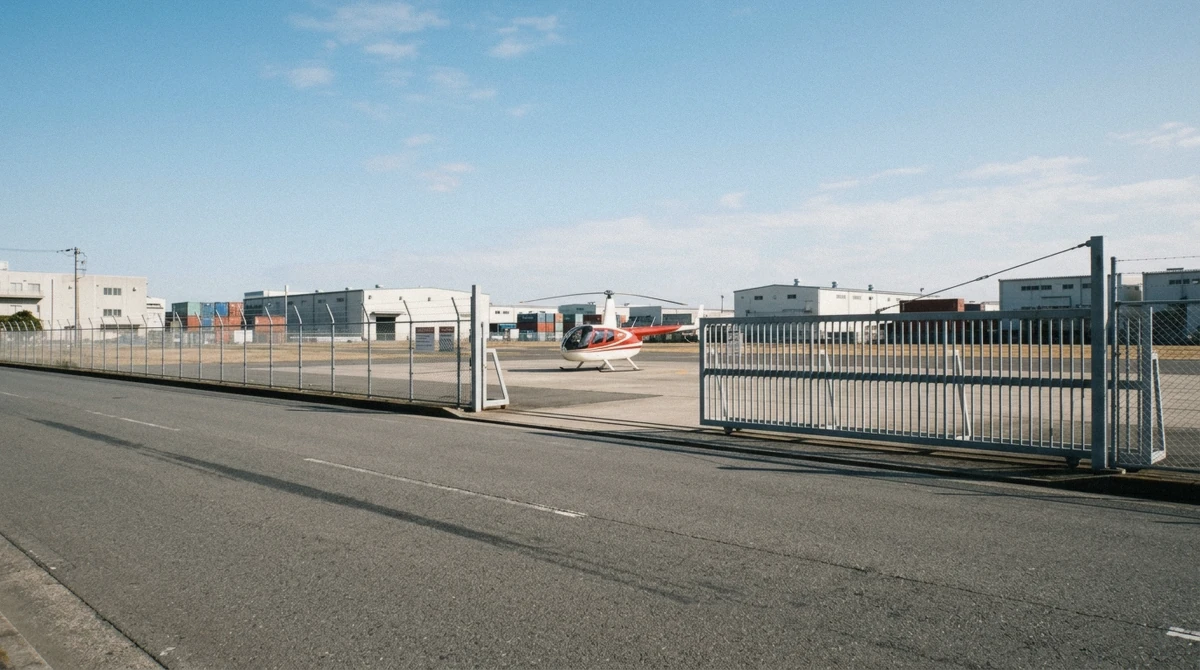
The simplest way to Tokyo Heliport is the JR Keiyo Line to Shin-Kiba Station, then the Toei Ki-11-Ko bus from berth 1 or berth 2. That's about seven minutes by train from Tokyo Station and under ten minutes by bus, for a flat fare of ¥210. A taxi from Shin-Kiba covers the same stretch in about five minutes for roughly ¥1,000 to ¥1,200.
Key takeaways
- Fastest realistic route: JR Keiyo Line to Shin-Kiba, then the Ki-11-Ko bus, about 7 minutes by train plus under 10 minutes by bus for ¥210 flat
- Cheapest route: the bus, at a flat ¥210 whether you pay by IC card or cash
- Walking is possible (2.2 km, 27 to 30 minutes) but there's little reason to, given how cheap and quick the bus is
- The return bus runs until 21:37 on weekdays, well past normal flight hours, so getting back isn't the problem, finding the right stop is (it isn't directly across the road)
- Driving means free parking only if you register your license plate with the operator in advance; there's no public parking otherwise
- If you'd rather skip all of this, flights with car or hotel pickup start from $765 per group and $841 per person
Every Way to Reach Tokyo Heliport, Compared
Fares and bus times below reflect the current fare structure and timetable. Tokyo's taxi fares rose in April 2026, so any older estimate you find elsewhere is already out of date.
| Option | Time | Cost | Best for |
|---|---|---|---|
| Train + bus | About 7 min by train, under 10 min by bus | ¥210 flat bus fare, plus standard train fare | Most travelers, the cheapest and simplest option |
| Train + taxi | About 7 min by train, about 5 min by taxi | Standard train fare plus roughly ¥1,000 to ¥1,200 | Door-to-door without waiting on a bus |
| Walking from Shin-Kiba | 27 to 30 minutes | Free | Only if you'd genuinely rather walk |
| Driving (advance registration) | Varies with traffic | Free for AIROS passengers who register their plate ahead; no public parking otherwise | Travelers who plan ahead and want their own car |
| Flight with car or hotel pickup | Door-to-door, no transfers to plan | From $765 per group (car) or $841 per person (hotel) | Travelers who'd rather not think about transit at all |
As of July 2026, the train-and-bus combination is the pick for nearly everyone: it's the cheapest way there, it runs all day at a steady frequency, and the return leg is confirmed all the way to 21:37 on weekdays.
Which Route Fits Your Morning?
If you are staying in central Tokyo with no car
take the JR Keiyo Line to Shin-Kiba, then the Toei bus from berth 1 or 2. It is the cheapest and most predictable option at ¥210, and it is what I use.
If your flight slot is early and you cannot risk the timing
ride the train to Shin-Kiba and take a taxi from the rank on the east side of the bus terminal. It is about 5 minutes and roughly ¥1,000 to ¥1,200, and it removes the only variable left.
If you are coming straight from Haneda
the monorail to Tennozu Isle, then the Rinkai Line, runs about 30 minutes to Shin-Kiba. Remember the Rinkai Line is not JR, so a rail pass will not cover it.
If you are travelling with children, luggage or anyone who would rather not solve this
book a flight with pickup included and skip the whole problem. There is no luggage storage at the heliport, which makes this more than a convenience for anyone arriving with bags.
If you plan to drive
register your licence plate with the operator in advance. Parking is closed to the general public, so turning up without registering means nowhere to leave the car.
Where Exactly Is Tokyo Heliport?
Tokyo Heliport (4-7-25 Shinkiba, Koto Ward) opened in June 1972 under the Tokyo Metropolitan Government, and its roughly 147,153 square meter site holds 38 berths (10 large, 28 small), on reclaimed land at the eastern edge of Tokyo Bay. The closest train station is Shin-Kiba, itself a hub for three separate rail lines, a bus or taxi ride short of the heliport gate. The map below marks the heliport, the Shin-Kiba transfer point, and Tokyo Station as a reference for how the pieces line up geographically.
By Train and Bus
Shin-Kiba Station is the transfer point for every train route to the heliport, and it's a busier interchange than the name suggests: three separate lines converge here. The JR Keiyo Line runs straight through it, and it's the line you want if you're coming from Tokyo Station or anywhere else on the JR network. The Tokyo Metro Yurakucho Line and the Rinkai Line both terminate at Shin-Kiba instead of passing through.
One gotcha worth knowing before you board: the Rinkai Line is not a JR line, so a Japan Rail Pass doesn't cover it. If that's the line you're arriving on, you'll need a separate ticket or an IC card fare for that leg.
Getting from Shin-Kiba to the heliport by bus
- Take the JR Keiyo Line, Tokyo Metro Yurakucho Line, or Rinkai Line to Shin-Kiba Station
- Head out to the station's bus terminal
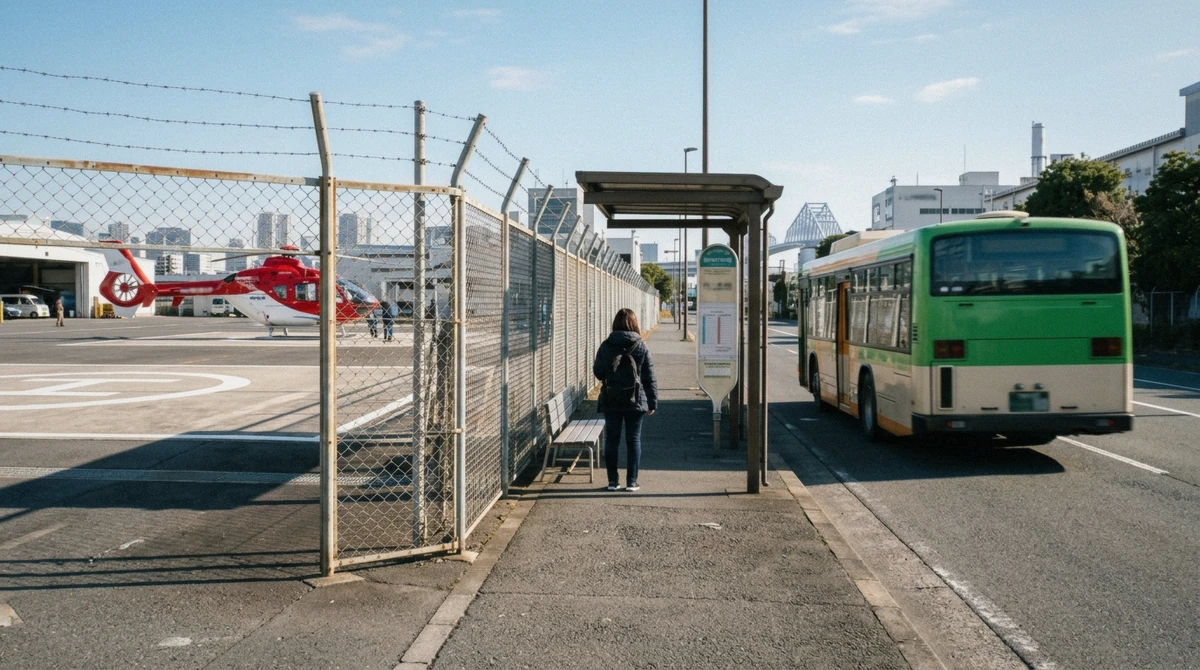
- Board the Toei Bus route Ki-11-Ko from berth 1 (bound for Wakasu Camp Ground) or berth 2 (bound for Toyocho Station via the Shin-Kiba loop); berths 3 and 4 run different routes and won't get you there
- Pay ¥210 as you board, at the front door, by IC card or cash, it's the same flat fare either way
- Ride two stops and get off at Tokyo Heliport Mae
- Walk toward the heliport; the entrance sits slightly to the right as you face it from the bus stop, easy to miss if you're expecting it dead ahead
Paying at the front door as you board, rather than at the back door on exit, is standard for Toei buses inside Tokyo's 23 wards, though it can catch out anyone used to bus systems elsewhere in Japan where you tap on exit instead.
How long the ride itself takes depends on who you ask: the operator puts it at about five minutes, while the Tokyo Port Bureau, which runs the heliport, says closer to seven. Either way, plan on under ten minutes once you're on board. Buses run roughly four to six times an hour between 07:00 and 18:00, so you're rarely waiting long for one.
Getting back is where most guides go quiet, and it's the detail worth knowing before you fly, not after. On weekdays, the first return bus toward Toyocho leaves the heliport at 06:54 and the last one leaves at 21:37, comfortably bracketing normal flight hours, so you're not going to get stranded. What does trip people up is that there's no bus stop directly across the road from where the outbound bus drops you off.
You can't just cross the street for the ride back. Give yourself a few extra minutes to find the correct stop for your direction, or ask heliport staff to point you to it.
Flight slots start early, and how predictable this trip is changes across the day. Here's what to expect rather than a fixed number of minutes.
| Time of day | What to expect | What I'd allow |
|---|---|---|
| Early morning | Trains running on schedule, roads still clear, this is the most predictable slot of the day | Little reason to pad your timing beyond the usual buffer |
| Mid-morning | Buses running every 10 to 15 minutes within the four-to-six-per-hour window | Fine as scheduled, no extra buffer needed |
| Evening rush | Trains more crowded, road traffic slower, taxi becomes the least predictable option | Build in extra time, especially if you're driving or taking a cab |
By Taxi
A taxi from Shin-Kiba to the heliport takes about five minutes, and the rank is on the left, or east, side of the station's bus terminal, easy to find once you know to look for it rather than the bus stop next to it.
Expect somewhere around ¥1,000 to ¥1,200 for the ride, though treat that as a rough figure rather than a quote. Tokyo's taxi fares rose by roughly 10 percent on 20 April 2026, so older estimates you might find elsewhere are already out of date. The current 23-ward rate structure runs ¥500 for the first 1.0 kilometer, then ¥100 for every 232 meters after that, with a slower ¥100-per-1-minute-25-second rate kicking in during heavy traffic, and a 20 percent late-night surcharge between 22:00 and 05:00.
For the return leg, don't assume a taxi will be waiting at the heliport gate. If you'd rather ride back by taxi than by bus, it's simplest to arrange one in advance through your hotel or a taxi app rather than count on flagging one down on arrival.
Walking
It's 2.2 kilometers from Shin-Kiba Station to the heliport, which works out to about 27 to 30 minutes on foot. An often-repeated claim of a 15-minute walk is wrong, don't plan around it. The heliport sits inside Shinkiba's port and industrial district, and honestly, there's little reason to walk it: the bus covers the same distance in under ten minutes for ¥210, so unless you specifically want the walk, take the bus instead.
By Car
Parking at the heliport itself is closed to the general public. It's the management office's own lot, not a public facility, so you can't simply drive up and park. The one exception is AIROS passengers, who can park for free if they register their license plate with the operator in advance; without that registration, there's nowhere to leave a car on-site.
If you're driving in from elsewhere in Tokyo, build the pre-registration step into your booking rather than assume you'll sort it out on arrival.
The Zero-Hassle Option: Flights With Pickup
Every route above assumes you're getting yourself to Shin-Kiba and figuring out the last stretch on your own. If you'd rather skip that entirely, two of the flights bundle the ride in. The 10-Minute Tour with Private Car Pickup and Drop-off collects you and brings you straight to the heliport and back, from $765 per group of up to three.
The 10-Minute Tour with Hotel Pickup and Drop-off does the same from your hotel, from $841 per person. For the full breakdown of how the per-group and per-person pricing works out against the flight alone, see the price of each flight.
If you already have an easy run to Shin-Kiba, the bus and train combination is hard to beat on cost, it's a fraction of what either pickup flight adds. Where the pickup option earns its price is if you're short on time, traveling with a lot to carry, or simply don't want to think about berths and bus stops on the day of your flight. It removes every question this guide answers, at a price.
From Other Starting Points
Shin-Kiba is the constant. Wherever you're starting from in Tokyo, you're ultimately routing through this one station before the final bus, taxi, or walk. Here's how the trip looks from a few common starting points.
| From | Route | Time |
|---|---|---|
| Tokyo Station | JR Keiyo Line, direct, two stops (Hatchobori, then Shin-Kiba) on the Rapid | About 7 minutes on the train |
| Ginza | Walk to Ginza-itchome Station, then the Yurakucho Line direct to Shin-Kiba | About 11 minutes plus the walk to the station |
| Yurakucho | Tokyo Metro Yurakucho Line, direct | About 12 minutes |
| Shinjuku | JR Chuo-Sobu Line to Ichigaya, transfer to the Yurakucho Line | About 30 minutes |
| Shibuya | JR Saikyo Line, which often runs straight through onto the Rinkai Line with no transfer, terminating at Shin-Kiba | Roughly half an hour |
| Haneda Airport | Tokyo Monorail to Tennozu Isle, then the Rinkai Line, with about a 5-minute transfer between them | Roughly 30 minutes total |
From Tokyo Station
The ride itself is only about seven minutes, but that number undersells the Tokyo Station experience: the Keiyo Line's platforms sit a long way from the Marunouchi and Shinkansen side of the station, far enough that the seven minutes is ride time and not door-to-door. Leave yourself real slack for that walk on top of the ride time, or you'll misjudge how much runway you actually have before your check-in slot.
From Ginza and Yurakucho
Both are a short, direct trip on the Yurakucho Line. From Ginza you'll need a short walk to Ginza-itchome Station first; from Yurakucho Station you're already on the line.
From Shinjuku
This one needs a transfer, JR Chuo-Sobu Line to Ichigaya, then onto the Yurakucho Line, and runs about 30 minutes total. It's still a straightforward, one-transfer trip, just longer than the eastern-side stations.
From Shibuya
The JR Saikyo Line frequently through-runs onto the Rinkai Line without requiring you to change trains, terminating right at Shin-Kiba, roughly half an hour door to door. Remember the Rinkai Line leg isn't covered by a Japan Rail Pass, so keep an IC card or separate ticket ready for that portion.
From Haneda Airport
Take the Tokyo Monorail to Tennozu Isle (about 14 minutes), then transfer to the Rinkai Line for about 11 minutes to Shin-Kiba, with roughly 5 minutes to make the change. All told, budget around 30 minutes from touchdown at Haneda to Shin-Kiba, before the final bus or taxi to the heliport itself.
What's Actually at the Heliport
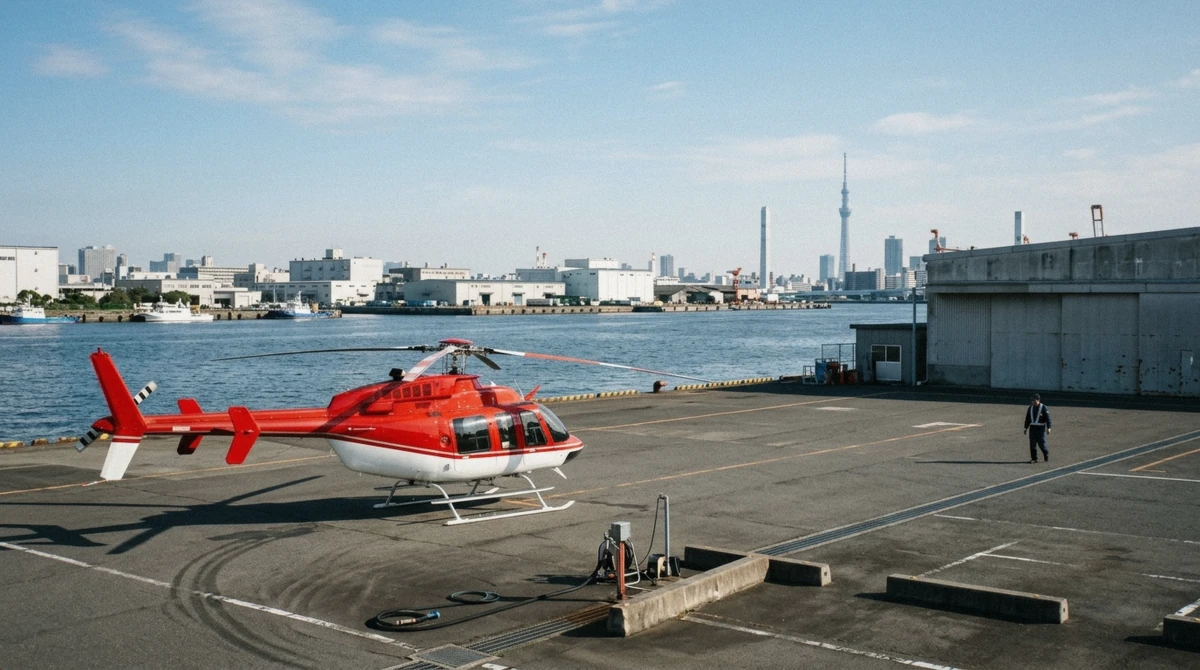
Set your expectations for the heliport itself low, and you won't be disappointed. The Tokyo Port Bureau's own listing for the facility comes up empty for an information desk, a lounge, luggage storage, rental cars, a restaurant, or an observation deck. There's no cafe, no shop, nothing to browse while you wait.
This is a working airfield, also home to the Metropolitan Police and Tokyo Fire Department's aviation units, and the news helicopters flown by NHK, Nippon TV, TBS, Fuji TV, TV Asahi, TV Tokyo, and Kyodo News, not a passenger terminal built for tourists. Eat before you arrive.
What there is: a waiting room and toilets, including a multi-purpose restroom with a changing table and ostomate facilities.
Ground photography is banned across the heliport grounds, part of the site's own counter-terrorism security measures, so keep the camera away during boarding, take-off, and landing. Photography once you're airborne is fine, and if you're bringing a GoPro, it needs to be hand-held rather than mounted. Sightseers can't simply walk in either; the grounds only admit passengers with a confirmed booking.
Your assembly time is your check-in time, and take-off follows roughly 30 minutes later. The operator is explicit that arriving too early doesn't help you, there's nowhere to wait it out beyond the one waiting room, and it's one of the traps worth avoiding on a flight day. Since morning light tends to make for the clearest photos, it's worth reading about picking a clear-air morning before you choose a slot.
Published operating hours differ slightly depending on the source: the Tokyo Port Bureau lists 08:30 to 16:30, AIROS states 08:00 to 16:30, and night flights are generally not part of the schedule. In practice, the operator's own hours are what govern your specific flight. Wind and weather can also ground a flight regardless of the clock; see how a weather cancellation plays out if that's a concern for your dates.
Accessibility and Luggage
The heliport itself is built for wheelchair access: the pathways from the entrance to the boarding area are wheelchair-accessible, and every Toei bus on the Ki-11-Ko route is a non-step bus with a wheelchair space and ramp. Where accessibility runs out is the aircraft itself. Boarding means managing a step of about 20 centimeters into the cabin, unaided, since the operator requires every passenger to get in and out on their own.
The heliport grounds are accessible; the aircraft isn't step-free. For the full rundown of who can and can't fly, see the boarding and weight rules.
Traveling with young children raises a related question, since a small child managing that same step is part of what decides whether they can fly at all. Our guide to flying with children covers what to expect at check-in if that's you.
There's no luggage storage at the heliport itself, and no published baggage policy beyond the standard no-bags-in-the-cabin rule. Whether Shin-Kiba Station has coin lockers isn't something the heliport or the operator publishes, so don't count on finding one there. The safer plan is to leave anything you don't need at your hotel before you set out.
Frequently Asked Questions
How do you get to Tokyo Heliport without a car?
Take the JR Keiyo Line, or the Yurakucho or Rinkai Line, to Shin-Kiba Station, then either the Toei Ki-11-Ko bus (under ten minutes, ¥210 flat) or a taxi (about five minutes). Both beat walking, which takes 27 to 30 minutes over 2.2 kilometers.
Is there a direct train to Tokyo Heliport?
No. The nearest station is Shin-Kiba, and you'll need to finish the trip by bus, taxi, or on foot from there, there's no rail line running to the heliport gate itself.
Which bus goes to Tokyo Heliport from Shin-Kiba Station?
The Toei Bus route Ki-11-Ko, boarding from berth 1 (toward Wakasu Camp Ground) or berth 2 (toward Toyocho Station); berths 3 and 4 run different routes. Get off two stops later at Tokyo Heliport Mae.
What time does the last bus back from Tokyo Heliport leave?
On weekdays, the last return bus toward Toyocho leaves at 21:37, and the first leaves at 06:54, which comfortably covers normal flight hours. Just remember the stop for the return direction isn't directly across the road from where you're dropped off.
Is there parking at Tokyo Heliport?
Not for the general public. The lot belongs to the management office, and the only way in is as an AIROS passenger who has registered a license plate with the operator in advance.
How accessible is Tokyo Heliport?
The pathways and the Toei buses serving it are wheelchair accessible, but boarding the helicopter itself involves an unaided step of about 20 centimeters into the cabin, so the aircraft isn't step-free even though the heliport grounds are accessible.
What's available to eat or store luggage at Tokyo Heliport?
Nothing. It's a working airfield with a waiting room and toilets, not a terminal, there's no cafe, shop, or luggage storage on site. Eat beforehand and leave extra bags at your hotel.
Getting to Tokyo Heliport isn't the hard part of this trip, it just isn't obvious until someone's actually stood at the bus stop and worked it out. Seven minutes on the train, under ten on the bus, ¥210 total, and you're at the gate with time to spare if you don't cut it too close. If you'd rather hand the whole question off, the car and hotel pickup flights exist for exactly that.
Either way, once you're through the gate, it's worth already knowing why the flight is worth the trip out, and what the flight shows you once you're airborne, so the ten minutes in the air matches the effort it took to get there. Compare all the flights leaving Tokyo Heliport before you pick a slot.